





Latest Version
October 08, 2024
Microjoy Games Limited
Board
iOS
0
Report a Problem
More About :game
Developed by Microjoy Games Limited, Bus Fever combines the familiar idea of car escape puzzles with a colorful bus-and-passenger matching system.
At first, the objective appears simple: move vehicles and match passengers with the correct color. As the boards become more crowded, however, every move matters. Moving one vehicle can open a path for another—or create a new traffic problem.
The result is a casual puzzle experience that rewards planning, spatial awareness, patience, and careful sequencing.
How Bus Fever Works
Each level presents a busy parking or transportation area filled with vehicles and passengers.
Your objective is to clear the board by:
- Identifying the available vehicle movements.
- Matching passengers with vehicles of the same color.
- Moving vehicles without blocking important routes.
- Creating space for additional vehicles.
- Using boosters when a position becomes difficult.
- Clearing the entire board to complete the level.
The App Store describes the central objective as matching passengers with their color-coded vehicles and removing all vehicles from the board.
Traffic and Parking Jam Gameplay
The game's main attraction is the feeling of being trapped inside a crowded parking area.
Vehicles can block one another, meaning you cannot always move the vehicle you want immediately. Instead, you have to think several steps ahead and decide which vehicle should move first.
This gives the game its strategic character without making the controls difficult to understand.
Color Matching System
Color matching is central to the gameplay.
Passengers and vehicles are associated with different colors, and players need to connect the correct groups while keeping the board manageable.
A good strategy is to identify which vehicles currently have the clearest path and which moves will create additional parking space.
Vehicle Variety
Bus Fever features different types of vehicles, including buses, cars, and special vehicles.
Different vehicle sizes and movement patterns can change the way a level needs to be solved. Longer vehicles can require more room, while smaller cars may be useful for opening narrow sections of the board.
Some levels can also introduce emergency vehicles such as ambulances and fire trucks, adding another layer of planning.
Puzzle Levels
The game offers a large number of puzzle layouts, with difficulty increasing as players progress.
The current App Store description highlights thousands of tile puzzles in various layouts, providing substantial content for players who enjoy repeated short puzzle sessions.
Some levels are straightforward and relaxing, while others require considerably more planning.
Boosters and Power-Ups
Boosters can help when a puzzle becomes difficult.
Depending on the situation, power-ups can provide additional options for clearing vehicles or recovering from a problematic sequence.
However, experienced players may prefer to save boosters for genuinely difficult boards rather than using them on every level.
Daily Challenges
Bus Fever also includes daily challenges with special rewards, adding an additional reason to return to the game regularly.
Daily content can provide a break from the standard progression and give experienced players new layouts to solve.
Gameplay Strategy
The game rewards strategic thinking rather than simply tapping quickly.
A successful player needs to understand:
- Vehicle positions
- Available parking spaces
- Passenger colors
- Vehicle sizes
- Movement order
- Future routes
- Potential blockages
- Booster timing
The best move is not necessarily the move that immediately removes a vehicle. Sometimes the correct strategy is to create space first so that several later moves become possible.
Beginner's Guide
Start With the Most Accessible Vehicles
Look for vehicles that already have a clear route out of the parking area.
Removing these first can create valuable space.
Match Colors Carefully
Before moving a vehicle, check where its passengers are located and whether the move will create a useful opening.
Don't Fill Every Available Space
Keeping some free space can make later moves much easier.
Think Two or Three Moves Ahead
Instead of considering only the current move, ask what the board will look like afterward.
Save Boosters
Boosters are most valuable when the board becomes genuinely difficult.
Stay Patient
The game is designed around planning. Moving too quickly can create unnecessary traffic problems.
Advanced Strategy Tips
Clear Small Vehicles First
Small cars can often be removed from the board more easily than long buses. Clearing them may create the space required to maneuver larger vehicles.
Protect Open Parking Spaces
An empty space is a valuable resource. Avoid filling every available position unless the move directly contributes to solving the level.
Plan Around Large Vehicles
Long buses can require multiple spaces and may become difficult to reposition once the board becomes crowded.
Watch Special Vehicles
Emergency vehicles can introduce additional restrictions in some levels. Plan their movement before committing to a sequence.
Avoid Unnecessary Resets
If a position looks difficult, examine the board carefully before restarting. Often one carefully planned move can create enough space to recover.
Controls and Interface
The game uses simple touchscreen controls.
Players tap or interact with vehicles and puzzle elements to move them around the board. The interface is designed to be easy to understand, allowing players to focus on planning rather than complicated controls.
Because it is designed for mobile and tablet devices, Bus Fever works particularly well for short sessions.
Game Progression
Progression is based primarily on completing puzzle levels and tackling increasingly complex layouts.
As players move forward, they encounter more complicated traffic arrangements, additional obstacles, different vehicle configurations, and harder decisions.
This gradual increase in complexity makes the early levels suitable for beginners while giving experienced puzzle players more demanding challenges.
Graphics and Visual Style
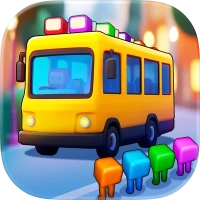
Bus Fever uses colorful 3D-style graphics and bright vehicle designs.
The visual presentation is intentionally approachable rather than realistic. Vehicles, passengers, parking areas, and interface elements are designed to make the puzzle state easy to understand at a glance.
The App Store specifically highlights beautiful graphics and a variety of layouts.
Sound and Atmosphere
The game combines casual puzzle mechanics with a relatively relaxed atmosphere.
Despite the traffic-jam theme, there is no need to rush through every puzzle. The App Store description specifically promotes the experience as suitable for relaxing play and notes that there is no general time limit.
Difficulty
Difficulty: Easy to Moderate
The controls are simple, but later puzzles can require substantial planning.
The game's difficulty comes primarily from increasingly crowded boards rather than complicated controls.
Players who enjoy logic and spatial puzzles should find the learning curve approachable, while harder levels can provide a satisfying challenge.
Game Modes
Bus Fever is primarily a single-player puzzle game.
Its main experience revolves around completing the regular puzzle progression, while additional daily challenges and different layouts provide variety.
There is no traditional competitive multiplayer campaign.
Offline Play
The App Store description states that Bus Fever can be played without Wi-Fi, making it suitable for offline puzzle sessions.
This makes it a convenient option for travel, commuting, or situations where an internet connection is unavailable.
iPhone and iPad Support
Bus Fever is designed for both iPhone and iPad. Apple's current US listing identifies it as a game designed for iPad and compatible with iPhone and iPad devices.
The current listing reports an app size of approximately 304.2 MB and an age rating of 9+.
Technical Details
| Detail | Information |
|---|---|
| Game | Bus Fever - Car Parking Jam |
| Developer | Microjoy Games Limited |
| Genre | Puzzle / Board |
| Gameplay | Parking, vehicle sorting, color matching |
| Platforms | iPhone, iPad |
| App Size | 304.2 MB |
| Age Rating | 9+ |
| Multiplayer | No traditional multiplayer |
| Offline Play | Yes |
| Language | English |
| Price | Free with in-app purchases |
Apple currently lists Bus Fever as free with in-app purchases, with English as its listed language and support for iPhone and iPad.
Updates and Version History
The App Store currently lists frequent maintenance updates focused on performance improvements and bug fixes. Version 1.19.3, dated July 29, is the latest version shown in the current listing.
Previous releases have included new features as well as ongoing performance and stability improvements.
In-App Purchases
Bus Fever is free to download but includes optional in-app purchases.
The game also offers boosters and other resources that can affect progression.
Players who prefer a completely free experience should be aware that the monetization system forms part of the game's design. User reviews on Apple's listing show both positive feedback about the gradual difficulty and criticism concerning ads, boosters, and purchases.
Player Experience
The current US App Store listing shows 4.7 out of 5 from approximately 37,000 ratings, indicating strong overall user reception.
Reviews praise the game's gradual difficulty curve and its ability to provide relaxing puzzle sessions. Other users have criticized advertising behavior, progression costs, and the use of paid resources on harder levels.
This makes Bus Fever a good example of a game that can be enjoyable for casual puzzle players while still having monetization considerations worth knowing about before playing.
Pros and Cons
Pros
- Easy-to-understand controls
- Colorful 3D visuals
- Large collection of puzzle layouts
- Strategic traffic-jam gameplay
- Passenger and vehicle color matching
- Multiple vehicle types
- Boosters and power-ups
- Daily challenges
- Suitable for short sessions
- Offline play
- Supports iPhone and iPad
- Gradually increasing difficulty
Cons
- Includes in-app purchases
- Advertising can interrupt the experience
- Some harder levels may encourage booster use
- Certain players may find later progression frustrating
- Gameplay can become repetitive for players who prefer greater variety
Who Should Play Bus Fever?
Bus Fever is a good choice for players who enjoy:
- Parking puzzle games
- Car escape games
- Traffic jam puzzles
- Color matching games
- Tile puzzles
- Logic games
- Casual board games
- Brain-training-style challenges
- Mobile puzzle games
- Offline games for iPhone and iPad
It is particularly suitable for people who like games that can be played in short bursts without requiring complicated controls.
Who Might Not Enjoy It?
Players looking for a story-driven adventure, action gameplay, competitive multiplayer, or deep simulation mechanics may find Bus Fever too simple.
Likewise, players who strongly dislike advertising or optional purchases may want to consider the game's monetization before committing to long-term progression.
Comparison With Traditional Parking Games
Unlike a traditional parking simulator, Bus Fever does not focus on realistic steering, driving physics, or precise parking.
Instead, it turns parking congestion into a logic puzzle.
The player is essentially solving a moving traffic problem: determine which vehicle should leave first, create enough space, match the correct colors, and prevent the board from becoming blocked.
This makes it closer to a car escape puzzle and color-sorting game than a conventional driving simulator.
Expert Rating
Overall Rating: 8.2/10
Puzzle Design: 8.4/10
Controls: 8.8/10
Graphics: 8.2/10
Difficulty Curve: 8.3/10
Content Variety: 8.1/10
Replay Value: 8.4/10
Relaxation Factor: 8.5/10
Monetization: 6.8/10
Final Verdict
Bus Fever - Car Parking Jam takes a familiar traffic-jam concept and turns it into an accessible color-matching puzzle.
The formula is simple: match passengers with the correct vehicles, clear the parking area, create space, and plan your moves carefully. As the boards become more crowded, the game gradually shifts from casual tapping to genuine spatial strategy.
Its large number of layouts, daily challenges, vehicle variety, boosters, offline play, and iPhone/iPad support make it a convenient puzzle game for short sessions.
The main drawback is monetization. Although the game is free to download, it contains in-app purchases, and user reviews show mixed opinions about advertising and progression-related purchases.
For players searching for a parking jam game, car escape puzzle, bus matching game, traffic puzzle, or casual color-sorting game, Bus Fever offers an easy-to-learn experience with plenty of levels to explore.
Frequently Asked Questions
What is Bus Fever - Car Parking Jam?
Bus Fever is a casual puzzle game where players match passengers with color-coded vehicles and solve crowded parking and traffic layouts.
Is Bus Fever available on iPad?
Yes. The game is designed for iPad and is also available on iPhone.
Is Bus Fever free?
Yes. The game is free to download, but it includes optional in-app purchases.
Does Bus Fever require Wi-Fi?
No. The App Store description states that the game can be played without Wi-Fi.
How do you play Bus Fever?
Match passengers with vehicles of the same color, move vehicles through the parking area, create space, and clear the entire board.
Does Bus Fever have boosters?
Yes. Boosters can be used when players encounter difficult puzzle situations.
Does Bus Fever have different vehicles?
Yes. The game features buses, cars, and special vehicles with different movement characteristics.
Are there daily challenges?
Yes. Daily challenges provide additional puzzles and rewards.
Does Bus Fever have thousands of levels?
The current App Store description advertises thousands of tile puzzles in various layouts, providing a substantial amount of content.
Is Bus Fever a parking simulator?
Not in the traditional driving-simulation sense. It is better described as a parking-jam, vehicle-sorting, and color-matching puzzle game.
Is Bus Fever suitable for children?
Apple currently gives the game a 9+ age rating.
Bus Fever - Car Parking Jam is a colorful traffic and parking puzzle game built around vehicle movement, passenger matching, and spatial planning.
Its easy controls make the game immediately accessible, while increasingly crowded layouts force players to think carefully about movement order and available space. Daily challenges, boosters, different vehicle types, and a large collection of puzzle layouts provide additional variety.
With offline play and support for both iPhone and iPad, it is well suited to casual gaming sessions. Players should simply keep its advertising and in-app purchase systems in mind when deciding how they want to approach progression.
Rate the Game
User Reviews















Popular Games



















 Android
 iOS
iOS Windows
 Xbox
Xbox